
PIM System Strategy Review

8 Signs That Your Product Data Platform Is Holding Back Your Growth

PIM System Strategy Review

8 Signs That Your Product Data Platform Is Holding Back Your Growth

Is your PIM platform still future-proof?

Too many workarounds? Time for a reality check.

Many companies have successfully implemented and expanded their PIM systems in recent years. What was initially flexible and suitable often evolves, as complexity increases, into a solution that requires more and more effort: in data maintenance, integrations, change processes, and further development.
The key question, therefore, is no longer simply whether the PIM “works.”
Rather: Does your current product data platform still align with your growth goals, your system landscape, and your future architecture?
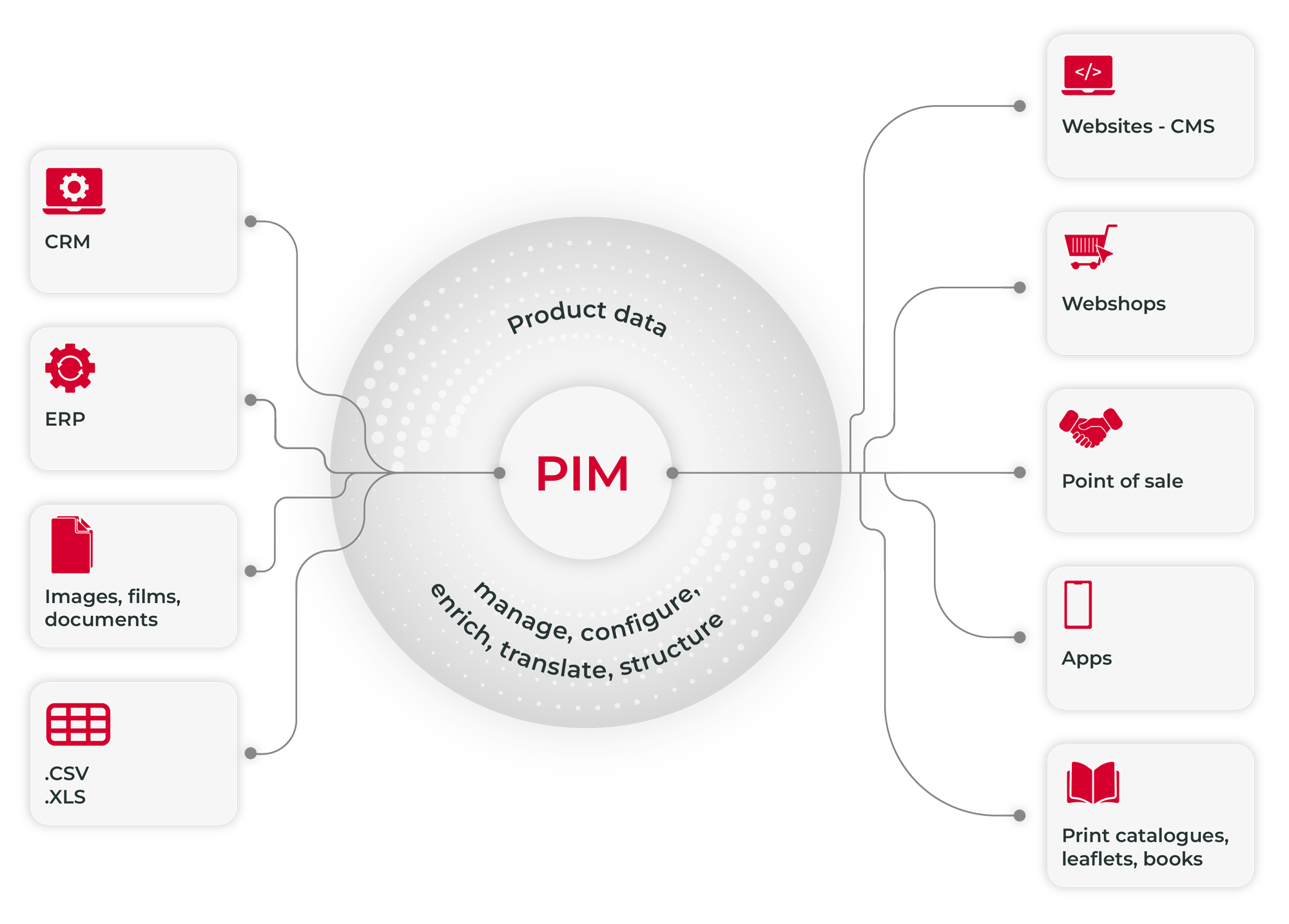
Manage, configure, enrich, translate, and organize product data and customer profiles
Sustainability is becoming a key evaluation criterion
Why This Question Is Becoming Even More Relevant Today

Sustainability is becoming a key evaluation criterion

Today, evaluating an existing product data platform is no longer just a matter of usability, integration effort, and operating costs. To an increasing extent, technological sustainability, regulatory requirements, and the ability to use data at scale are also determining whether a platform still aligns with the company’s vision.

Four Developments Are Particularly Relevant in This Context:
AI requires structured, reliable, and usable product data

Artificial intelligence significantly increases the value of product data — but only if that data is consistent, context-aware, and usable across systems. Companies that want to make greater use of product data in the future for content generation, translations, attribute enrichment, classification, search, consulting, or automation need a platform that supports high data quality, clear governance, and flexible deployment.

KI braucht strukturierte, verlässliche und nutzbare Produktdaten
Cloud- and API-enabled architectures are becoming the standard

Many companies are evolving their IT infrastructure toward the cloud, API-first approaches, composable architecture, and specialized platforms. This places greater demands on integration capabilities, scalability, the ability to release updates, and flexible data delivery. If an existing PIM/MDM environment hinders rather than supports this development, it creates a structural disadvantage for future digitalization initiatives. EU regulatory policy is reinforcing this trend, as product information is increasingly expected to be standardized, made available digitally, and accessible across systems.

Cloud- und API-fähige Architekturen werden zum Standard
Governance, transparency, and traceability are becoming more important

As the number of channels, markets, product assortment strategies, and regulatory requirements grows, so does the need for transparent data processes. Today, companies must be able to demonstrate more clearly than ever before where information comes from, how it is maintained, who is responsible for it, and in what contexts it is used.

Governance, Transparenz und Nachvollziehbarkeit werden wichtiger
The Digital Product Passport is increasing pressure on product data platforms

The EU Ecodesign for Sustainable Products Regulation (ESPR) established the regulatory framework for the Digital Product Passport. The regulation was adopted on June 13, 2024, and has been in effect since July 18, 2024. It provides that product information for the relevant product groups can be made available digitally in the future, in particular through a digital product passport. The specific implementation will take place in stages through delegated acts and work plans of the European Commission.
On April 16, 2025, the European Commission published the first work plan for 2025 through 2030. Among other things, the document identifies textiles and clothing, furniture (including mattresses), tires, and intermediate products made of iron, steel, and aluminum as priority product groups.
For companies, this means that the requirements for product data will not become less stringent in the coming years, but rather more specific, more structured, and more relevant from a regulatory standpoint.

Digitaler Produktpass
Fill out the free assessment and receive our analysis!

Question 01

Your PIM is more of a project than a platform

If every major adjustment to the data model, workflows, mapping, or structure becomes a project in its own right, a product data platform can quickly turn into a constant source of change management efforts.

Question:
Do you regularly need outside assistance or specialized technical solutions for major changes?

PIM Strategy Check

Question 02

Integrations have become a bottleneck

Today, product data does not exist in isolation. They must integrate seamlessly with ERP, e-commerce platforms, CRM, DAM, marketplaces, and other systems. When interfaces have evolved over time, are complex, or are prone to errors, it slows down not only IT but the entire business.

Question:
Are delays and risks today more likely to arise from the integration landscape than from the data itself?

Question 03

Academic departments are too dependent on IT

When product management, e-commerce, or marketing teams can't implement even simple changes on their own, it leads to unnecessary delays, coordination efforts, and ticket loops.

Question:
Are your departments currently unable to implement simple changes to product data, workflows, or channels on their own without involving IT?

Question 04

New channels, markets, or product lines take too long

Growth should not be a structural problem. If every new country organization, every additional channel, or every new product line generates a disproportionate amount of work, the system becomes a hindrance.

Question:
Does it take you an unreasonably long time, or does it involve a great deal of effort, to successfully implement new channels, markets, country organizations, or product lines?

Question 05

Actual profitability is worse than expected

Often, it is not the platform itself that is the biggest cost factor, but rather everything that surrounds it: external service providers, dependence on developers, infrastructure, maintenance, custom logic, and long implementation cycles.

Question:
Are you unsure of the actual total cost of your current PIM environment—including operations, customization, external service providers, maintenance, and further development?

Question 06

The architecture is no longer suited to the years ahead

Many companies are moving toward API-based, flexible, and specialized platform architectures. If the existing setup stands in the way of this vision, technical history can quickly become strategic baggage.

Question:
Is your current platform hindering your planned development over the next 24 months—for example, in terms of API capabilities, flexibility, or a more specialized platform architecture?

Question 07

AI and data-driven processes are reaching their limits

Artificial intelligence significantly increases the value of product data—but only if that data is consistent, context-aware, and usable across systems. Companies that want to make greater use of product data in the future for content generation, translations, attribute enrichment, classification, search, consulting, or automation need a platform that supports high data quality, clear governance, and flexible deployment.

If data models are difficult to extend, information is maintained inconsistently, or data cannot be made available to other systems and services in a clean, structured way, what starts out as a future issue can quickly turn into a structural problem.

Question:
Is your current platform unable to provide product data in a way that is consistent, context-aware, and cross-system for AI-powered processes?

Question 08

Your platform is only partially prepared for new regulatory requirements

The requirements for product data are increasing not only from a technological standpoint but also from a regulatory one. Issues such as transparency, traceability, data quality, and standardized delivery are becoming significantly more important. The Digital Product Passport, if nothing else, makes it clear that product data will be relevant in the future not only for internal processes and sales channels, but also for compliance, documentation, and digital traceability.

This requires robust data structures, clear lines of responsibility, versionable processes, and the ability to provide information consistently across systems.

Question:
Is your product data platform not sufficiently prepared to support future regulatory requirements—such as the Digital Product Passport—in a structured, consistent, and efficient manner?

I have read the privacy policy and consent to the collection, processing, and use of my data by CAS AG.

Purpose of data processing:
The collection, processing, and use of my data are intended to carry out the PIM System Strategy Check and to contact me in connection with it. In addition, I consent to receiving additional information via email about related products and services offered by CAS AG.

I can revoke my consent at any time, effective for the future—for example, by using the unsubscribe form or by sending an email to info@c-a-s.de.

For more information on data protection, please visit:
www.c-a-s.de/informationspflichten-nach-artikel-13-14-dsgvo

*Required field

9 + 1 = ?

Please enter the characters shown in the CAPTCHA to verify that you are human.

PIM Strategy Review: Progress

Please contact us

Your message

I have read the privacy policy and consent to the collection, processing, and use of my data, as well as to CAS AG sending me additional content via email. I can revoke my consent at any time by unsubscribing or sending an email to info@c-a-s.de.

*Required field

8 * 5 = ?

Please enter the characters shown in the CAPTCHA to verify that you are human.

Contact
CAS AG

+49-40-53 89 94-0 info@c-a-s.de Lübecker Straße 128, 22087 Hamburg

Hamburger Welle

Contact us directly

Feel free to schedule a personal consultation!

Thorsten Staude, Sales Manager, CAS AG

+49-234-93 597-0

thorsten.staude@c-a-s.de

Contact us directly

Feel free to schedule a personal consultation!

Thorsten Staude, Sales Manager, CAS AG

+49-234-93 597-0

thorsten.staude@c-a-s.de

Please contact us

Your message

I have read the privacy policy and consent to the collection, processing, and use of my data, as well as to CAS AG sending me additional content via email. I can revoke my consent at any time by unsubscribing or sending an email to info@c-a-s.de.

* Required field

9 * 3 = ?

Please enter the characters shown in the CAPTCHA to verify that you are human.

Contact

CAS AG

+49-40-53 89 94-0

info@c-a-s.de

128 Lübecker Straße, 22087 Hamburg