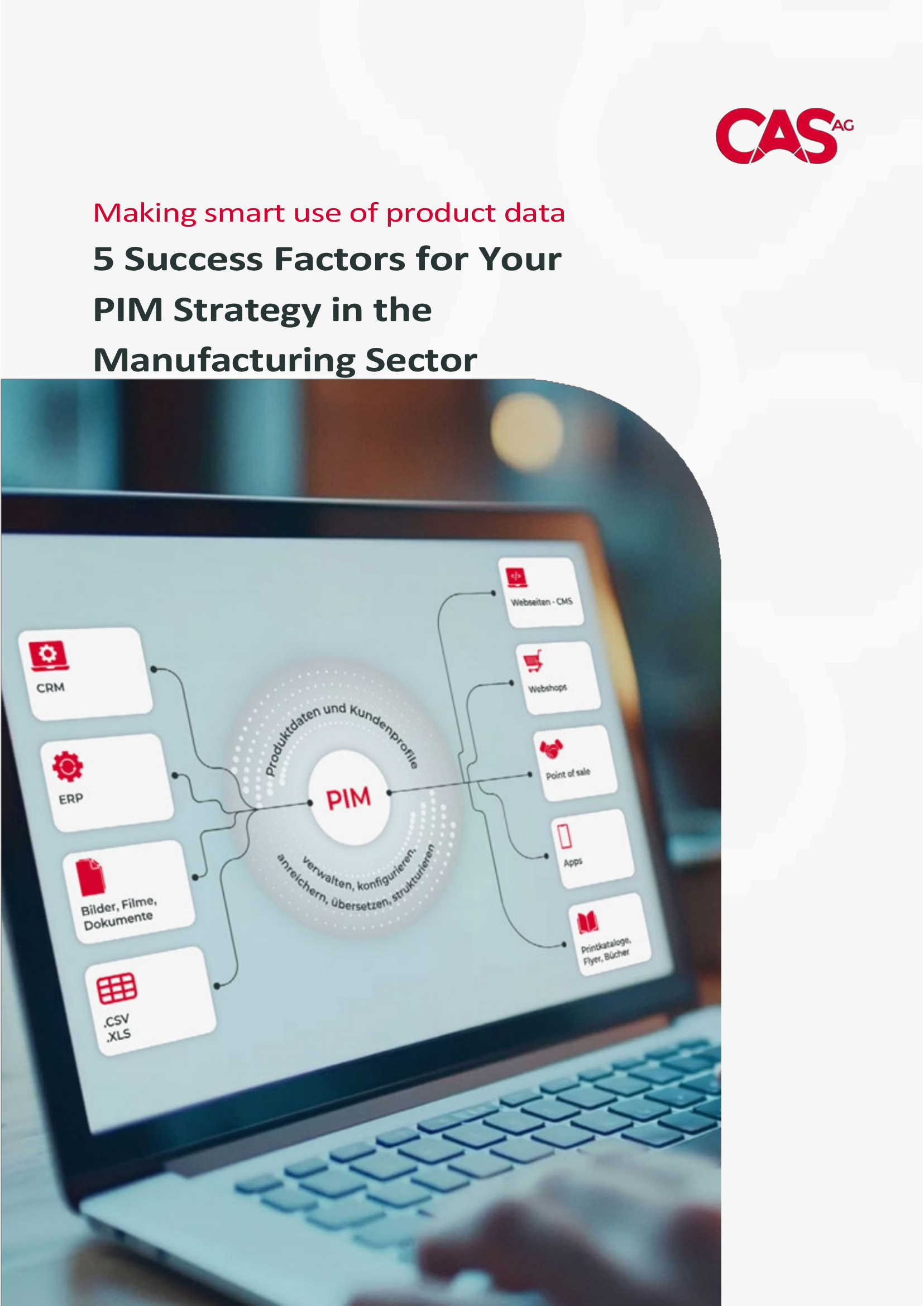
What is a PIM system?
A Product Information Management (PIM) system is a specialized software solution that helps companies centrally capture and manage all product data and ensure it is presented consistently across all sales channels. While ERP systems are primarily responsible for accounting and logistics, and DAM solutions focus on digital media, a PIM system handles the comprehensive management of product master data, metadata, and media assets.
Why a PIM System is Essential
- Multichannel Publishing: Whether it’s an online store, a marketplace, or a print catalog—with a PIM, you can always provide up-to-date and error-free product information.
-
Time and Cost Savings: Centralized data management reduces redundant steps and minimizes sources of error.
-
Scalability: Whether you have 100 or 10,000 products, a PIM scales with your needs and can be flexibly customized.
Features of a PIM System
A PIM system optimizes the entire information supply chain for product data — from suppliers through internal production sites to distribution centers and end customers. It serves as a single source of truth by centralizing, standardizing, and quality-assuring all product information. Through clearly defined workflows and access rights, it ensures that your data is always up-to-date, consistent, and complete. Key point: High-quality product data increases the likelihood of a purchase, minimizes returns, and reduces the associated effort and costs.
Flexible Data Modeling & Master Data Management
A PIM system allows you to define as many product classes, attributes, and hierarchies as needed, so that any product assortment can be accurately mapped. Using user-friendly forms, you can manage all master data — from item numbers to technical specifications to marketing texts—centrally in one place. By using automatic validation rules, you can ensure that only complete and accurate data records are included in the product catalog.
Data Enrichment & Translation Management
Using templates and rule sets, missing attributes such as dimensions, material specifications, or marketing claims can be automatically filled in. At the same time, you can manage translation processes for any number of languages using integrated workflow boards and external translation tools. Approval workflows ensure that only verified content is published in the various target markets.
Media Management for Images, Videos, and Documents
Your entire asset portfolio—product photos, 3D models, videos, and manuals — is stored with version control and automatically assigned to the corresponding items. Smart preview features and metadata filters make it easier to find and organize files. This way, you can always provide the right image or video format in any sales situation and avoid duplicate uploads.
Workflow and Rights Management
Role-based access control defines who is authorized to create, edit, or share which data, and provides clarity regarding responsibilities. Automated approval processes and escalation mechanisms ensure that corrections and revisions are completed on time. A comprehensive change log documents every action and supports audit requirements and compliance standards.
Automated Multichannel Publishing
Once product data has been maintained, it can be exported to all channels with the click of a button — from online stores and marketplaces to print catalogs. Configurable export profiles allow for channel- or target audience-specific customizations of text, images, and prices. By automating data extraction, you can reduce manual errors and speed up your time to market.
Interfaces & API Integration
Standardized interfaces seamlessly connect your PIM to ERP, CRM, or e-commerce systems and ensure real-time, bidirectional data exchange. Plug-and-play connectors for popular online store and marketplace platforms speed up implementation and minimize integration effort. This way, you can maintain data centrally, and inconsistent data becomes a thing of the past.
Benefits of a PIM System
A modern product information management system improves data quality and saves your company valuable time by automating manual tasks and streamlining processes.
Thanks to centralized, media-neutral data storage, marketing, sales, and external partners can maintain the same, consistent dataset at any time and from any location, while a finely granular role- and permission-based system ensures that only authorized users can modify specific information.
At the same time, the PIM enables seamless omnichannel distribution: product descriptions, images, and technical details can be automatically exported to e-commerce stores, websites, social media channels, catalogs, data sheets, or labels without the need for manual format conversion.
Integrated translation workflows and localization features also ensure that all product information is created, reviewed, and approved simultaneously in multiple languages — allowing you to reach your target audiences both domestically and internationally with consistently high-quality content.
With a PIM system, you can thus optimize both internal data management and global product communication across all relevant channels.
Who would benefit from a PIM system a good fit?
IT Management / Digital Transformation
A PIM system integrates heterogeneous ERP and e-commerce environments (SAP, Navision, Shopware, Magento, etc.) using standardized API and connector concepts. This allows you to minimize integration effort and ensure a seamless, consistent flow of product data. Centralized data flows reduce sources of error and take the strain off your IT teams during updates or system changes. At the same time, a PIM supports systematic digitization initiatives through automated interfaces and real-time data synchronization.
Sales / E-Commerce
With a PIM system, you can shorten your time to market by publishing new product data across all channels with the click of a button. Automated publishing workflows result in fewer media breaks and faster go-live phases for online stores, marketplaces, or mobile apps. Consistent, error-free product information boosts customer trust and leads to higher conversion rates. This ensures that your sales team remains agile and can respond flexibly to market demands.
Exports / International Marketing
For companies operating globally, a PIM system enables scalable multilingual capabilities and efficient localization processes. Integrated translation workflows and regional profiles reduce manual effort and shorten time to market in international markets. This allows you to reach customers around the globe with consistent, high-quality product information. At the same time, you always keep an eye on compliance and country-specific requirements.
Product Management
The PIM facilitates the implementation of industry standards such as ETIM, ECLASS, and GS1 through predefined templates and clean data models. Product managers can centrally manage complex classifications and attribute hierarchies and prepare them for use across all channels. This improves data quality and enables the efficient delivery of technical information to customers and platforms. A robust database supports strategic decision-making and accelerates processes throughout the entire product lifecycle.
Marketing Management / Catalog Management
With a PIM, you can generate automated print and digital catalogs on demand — customer-specific price lists, technical data sheets, or B2C brochures are available in just a few minutes. Layout templates and content filters ensure that only approved, error-free information is included in your marketing materials. This will help you reduce production costs and avoid time-consuming rework. At the same time, you’ll improve the efficiency of your catalog management and be able to respond more quickly to market or customer demands.
Implementation of a PIM System
The successful implementation of a Product Information Management (PIM) system is a strategic IT project that ensures the centralized management of all your product data, thereby optimizing time-to-market, data quality, and omnichannel publishing. To seamlessly integrate interfaces with ERP, e-commerce, and marketing tools, it is recommended to work closely with an experienced specialist partner—whether that be the software vendor or a specialized system integrator. The typical project workflow is divided into three phases: planning, implementation, and commissioning.
PIM in Practice
Industry 4.0 Ready – Your Strategic Enabler
The global PIM market is projected to grow from 15.6 billion USD in 2024 to 32 billion USD by 2029—an impressive compound annual growth rate (CAGR) of 15%.

Which illustrates the projected growth of the global PIM market from 2024 to 2029 at a CAGR of 15%.
Already, 50% of all companies actively use PIM; the other half are losing valuable efficiency (and competitiveness) due to a lack of centralized data management.


The chart shows baseline vs. “With PIM” for three key metrics—throughput times (≈ −50%), error costs (drastically reduced), and conversion rate (+20–50%).
PIM in Practice
Automated Integration & Accelerated Time-to-Market
Seamless system integration: An industrial supplier reduced the time required to launch new products by 60% and saved approximately 30,000€ per year—simply by automating data flows instead of spending 200×5 hours on manual maintenance (50€/hour).

"Seamless System Integration"—with a clear breakdown of the time and cost savings.

On “Accelerated Market Launch” – a clear comparison of time to market and additional revenue per campaign.
Faster Time to Market:
From six weeks to just ten workdays—and that’s with 1,000 stock-keeping units (SKUs)!
With an average revenue per unit (ARPU) of €10 and 1,000 SKUs, each additional sales day generates approximately €150,000 in additional revenue per campaign.
Here’s how to turn your IT landscape into a competitive advantage: quickly, transparently, and measurably.
PIM in Practice
Scale Globally & Boost ROI
Localization into 12 languages with no extra effort:
Thanks to the Translation Management System (TMS) integration, you can reduce error rates by 1% and save tens of thousands of euros annually.

"Localization in 12 languages with no extra effort" with TMS integration—highlighting the reduced error rate and annual savings.

Regarding “Standards & Classifications (ETIM/ECLASS/GS1)” – with a clear reduction of up to 70% in customer inquiries and approximately 0.5 FTE (~€20,000) less in support costs per year.
Standards & Classifications (ETIM/ECLASS/GS1):
Up to 70% fewer customer inquiries — which translates to approximately 0.5 FTE (∼€20,000) less in support costs per year.
Automated catalog and data sheet generation:
80% time savings per datasheet (€12,000 annual value per employee).

About “Automated Catalog and Datasheet Creation” — highlighting the 80% time savings per datasheet and the annual value of approximately €12,000 per employee.

Regarding the “ROI Scenario” — which includes a direct comparison between savings and additional revenue (€49,000) and PIM costs (€25,000), as well as the highlighted return on investment of 96%.
ROI Scenario:
Cost savings and additional revenue of €49,000, compared with PIM costs of €25,000, result in a return on investment of 96% — validated by studies and real-world experience.
With a PIM system, you can cut your turnaround times in half, drastically reduce error costs, and increase online conversion rates by 20–50%.

Baseline vs. “With PIM” for three key metrics — throughput times (≈ −50%), error costs (drastically reduced), and conversion rate (+20–50%).