In the financial industry, data management is much more than just a regulatory requirement. Regulatory requirements, such as MARISK, BASEL III, BCBS239, and DORA, call for a robust, integrated, and yet flexible data architecture. These regulations are critical for the accurate aggregation of risk data and the operational resilience of digital systems, enabling banks to accurately identify, monitor, and manage risks while complying with regulatory requirements. However, beyond ensuring compliance with regulations, well-integrated, high-quality data offers enormous potential for valuable insights and fosters data-driven decision-making and innovative business models.
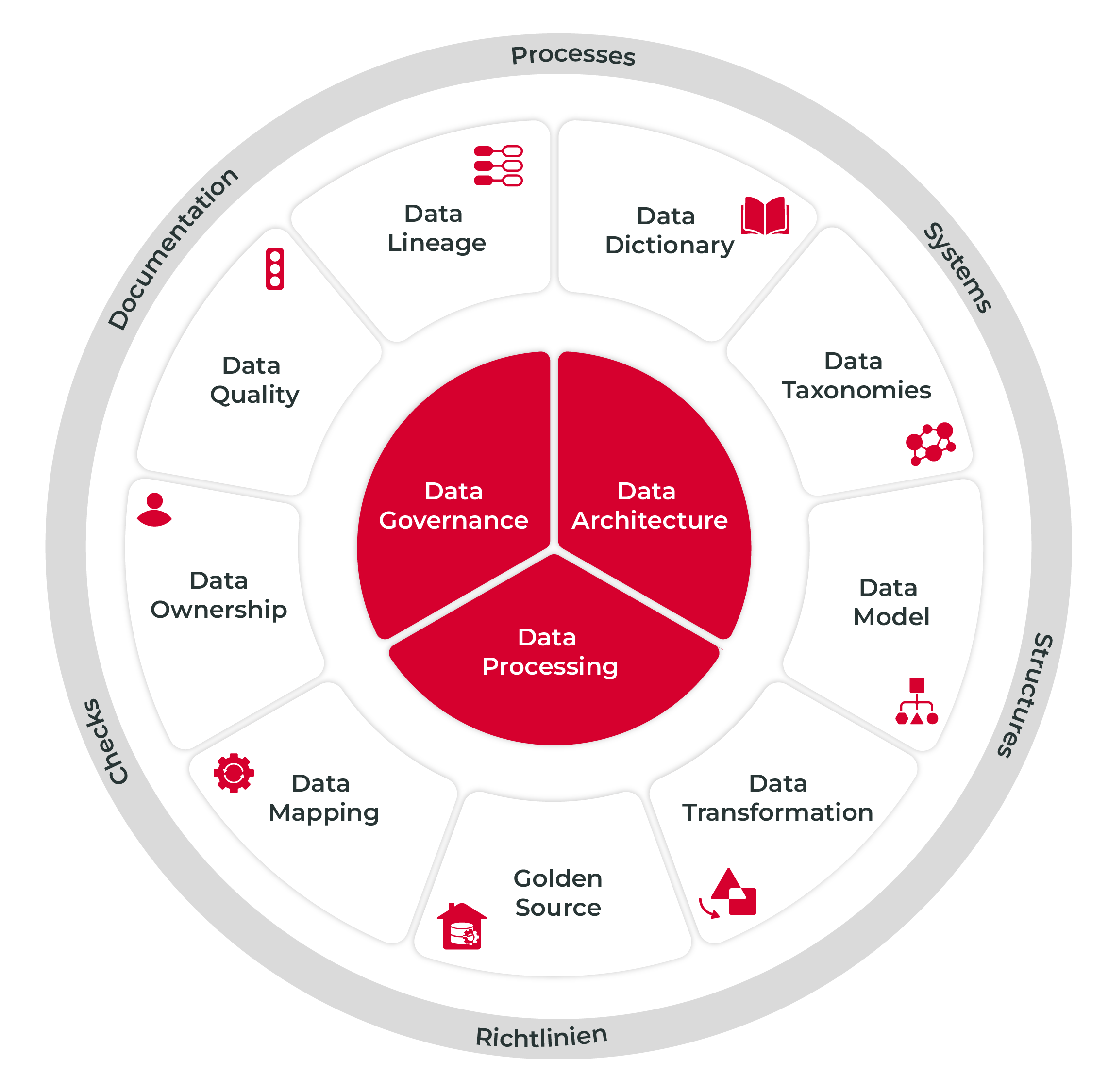
When implementing effective data management, it is important not only to consider the technical requirements but also to take into account the multifaceted aspects of a holistic approach. This includes:
- Data Governance: A comprehensive framework that covers the entire data lifecycle—from creation to reporting—and is embedded within the organization
- Data Quality and Security: Processes and measures that ensure the quality, integrity, security, and availability of your data.
- IT & Data Architecture: An integrated, future-proof, and robust system landscape that enables a unified, historical database and targeted reporting.
- Integration & Data Processing: Integration interfaces and data processing workflows that can be efficiently and flexibly adapted to new requirements, and whose processing steps are traceable end-to-end via data lineage.
- Data Harmonization: Tools and applications that use a data dictionary, business glossary, and data taxonomy to ensure a consistent understanding of data and information across the entire organization.
In the financial industry, data management is much more than just a regulatory requirement. Regulatory requirements, such as MARISK, BASEL III, BCBS239, and DORA, call for a robust, integrated, and yet flexible data architecture. These regulations are critical for the accurate aggregation of risk data and the operational resilience of digital systems, enabling banks to accurately identify, monitor, and manage risks while complying with regulatory requirements. However, beyond ensuring compliance with regulations, well-integrated, high-quality data offers enormous potential for valuable insights and fosters data-driven decision-making and innovative business models.
When implementing effective data management, it is important not only to consider the technical requirements but also to take into account the multifaceted aspects of a holistic approach. This includes:
- Data Governance: A comprehensive framework that covers the entire data lifecycle—from creation to reporting—and is embedded within the organization
- Data Quality and Security: Processes and measures that ensure the quality, integrity, security, and availability of your data.
- IT & Data Architecture: An integrated, future-proof, and robust system landscape that enables a unified, historical database and targeted reporting.
- Integration & Data Processing: Integration interfaces and data processing workflows that can be efficiently and flexibly adapted to new requirements, and whose processing steps are traceable end-to-end via data lineage.
- Data Harmonization: Tools and applications that use a data dictionary, business glossary, and data taxonomy to ensure a consistent understanding of data and information across the entire organization.
Data Management – Your path to a data-driven enterprise
Strategic Data Management: More Than Just Compliance
In the financial industry, data management is much more than just a regulatory requirement. Regulatory requirements, such as MARISK, BASEL III, BCBS239, and DORA, call for a robust, integrated, and yet flexible data architecture. These regulations are critical for the accurate aggregation of risk data and the operational resilience of digital systems, enabling banks to accurately identify, monitor, and manage risks while complying with regulatory requirements. However, beyond ensuring compliance with regulations, well-integrated, high-quality data offers enormous potential for valuable insights and fosters data-driven decision-making and innovative business models.
Focus on Technical Requirements and Holistic Approaches
When implementing effective data management, it is important not only to consider the technical requirements but also to take into account the multifaceted aspects of a holistic approach. This includes:
- Data Governance: A comprehensive framework that covers the entire data lifecycle—from creation to reporting—and is embedded within the organization
- Data Quality and Security: Processes and measures that ensure the quality, integrity, security, and availability of your data.
- IT & Data Architecture: An integrated, future-proof, and robust system landscape that enables a unified, historical database and targeted reporting.
- Integration & Data Processing: Integration interfaces and data processing workflows that can be efficiently and flexibly adapted to new requirements, and whose processing steps are traceable end-to-end via data lineage.
- Data Harmonization: Tools and applications that use a data dictionary, business glossary, and data taxonomy to ensure a consistent understanding of data and information across the entire organization.
Our expertise
Your Partner for Comprehensive, Effective Data Management
Our comprehensive data management approach combines in-depth banking expertise with many years of project experience gained from various IT transformation projects to help you achieve your specific project goals while adhering to regulatory requirements.
We specifically supplement our consulting approaches with AI-driven methods to efficiently analyze complex data relationships and create a structured basis for decision-making. This is always guided by our in-depth technical and data architecture expertise. With this approach, your data not only meets regulatory requirements but can also be used as a strategic resource to gain a competitive edge and develop innovative solutions.
We help you achieve comprehensive, effective data management and guide you through every step, from strategy development to implementation. This includes defining a future-proof data architecture, data modeling, the technical implementation of efficient data processing workflows, and mapping a complete end-to-end data lineage. In addition, we can develop a customized data quality framework, data dictionary, or data lineage application based on SAP Fiori for you.
Comprehensive Data Management for Your SAP Data Platforms
As part of a transformation project, a holistic approach to data management is of critical importance. Especially when building data platforms such as SAP FSDM, SAP HANA Platform, SAP Datasphere and SAP BW/4HANA into the overall architecture, a structured and comprehensive approach to your data is essential. Take advantage of our project experience and expertise in establishing data governance processes, developing customized data quality frameworks, and integrating data dictionary and data lineage applications.
We help you define clear roles and responsibilities in data management and implement a framework for managing your data throughout its entire lifecycle. With detailed documentation on data policies and standards, we help you make the most of your data.
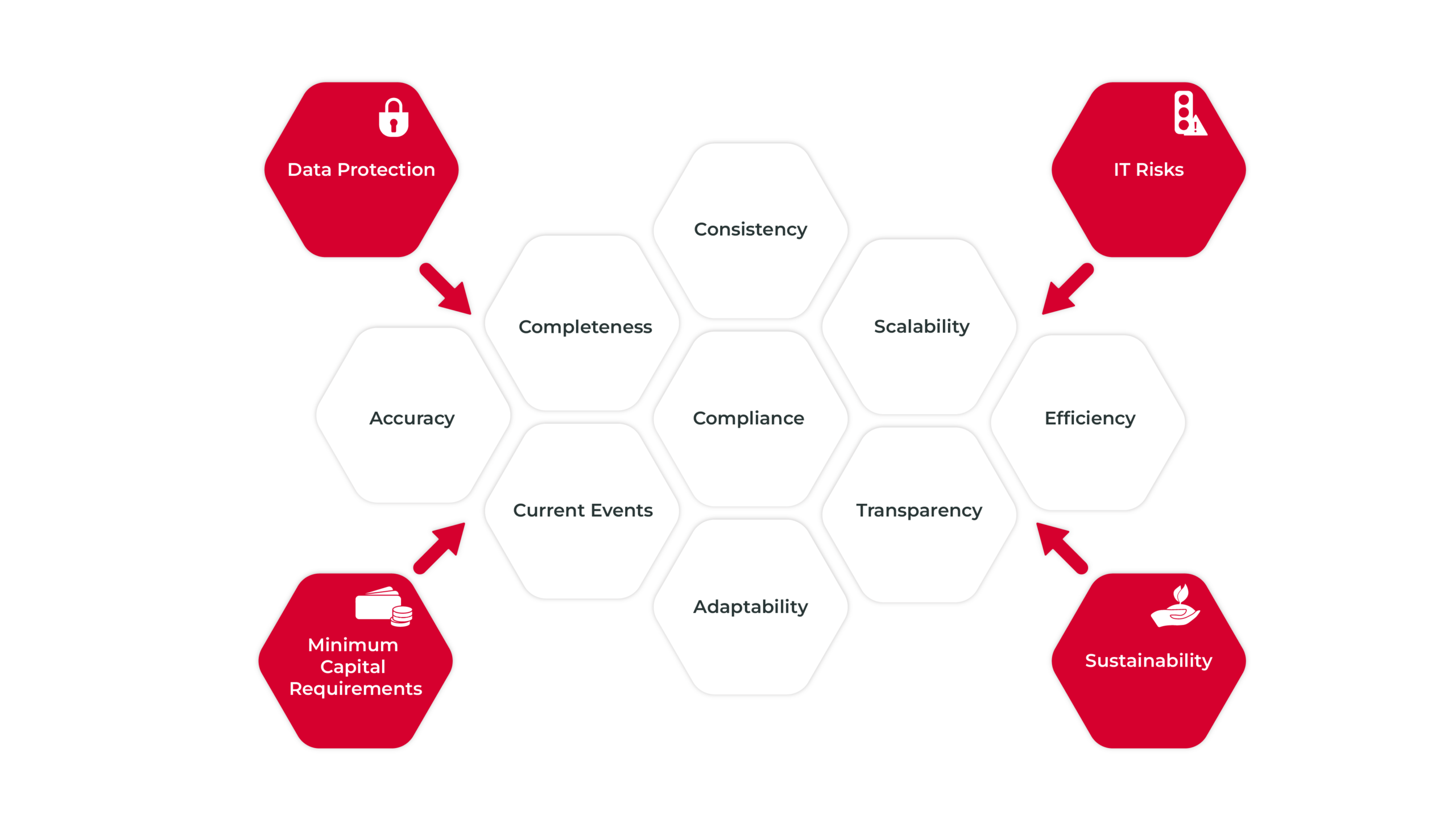
By establishing a data quality framework tailored to your requirements, we help ensure that your data meets the necessary standards for accuracy, completeness, consistency, timeliness, and adaptability.
To ensure complete traceability of the origin and processing of data from various sources, we implement both a data dictionary and data lineage for comprehensive data management. The resulting documentation of the structured and hierarchical categorization of your data—known as data taxonomy—serves as a guide for your business units.
To ensure compliance with regulatory requirements such as BCBS239, DORA, and the GDPR, we actively support your departments in preparing for audits and inspections.
Our expertise in data modeling encompasses the design and development of comprehensive business and physical data models that meet current standards for financial institutions. We work closely with the relevant department to accurately identify the requirements and translate them into a functional model.
Through a thorough analysis of your current data landscape, we guide you in designing customized data architectures and developing data strategies. Whether we’re building a data fabric with virtual data integration or harmonizing data to create a single point of truth—on-premises, in the cloud, or in a hybrid environment—we’ll work together to develop a future-proof data architecture.
Through a detailed analysis of your data, processes, and applications, as well as the development of development plans, we support you in making key strategic and architectural decisions. By leveraging modern data processing and storage technologies, we are working together to create a future-proof and flexible data architecture and system landscape.
We help you define clear roles and responsibilities in data management and implement a framework for managing your data throughout its entire lifecycle. With detailed documentation on data policies and standards, we help you make the most of your data.
By establishing a data quality framework tailored to your requirements, we help ensure that your data meets the necessary standards for accuracy, completeness, consistency, timeliness, and adaptability.
To ensure complete traceability of the origin and processing of data from various sources, we implement both a data dictionary and data lineage for comprehensive data management. The resulting documentation of the structured and hierarchical categorization of your data—known as data taxonomy—serves as a guide for your business units.
To ensure compliance with regulatory requirements such as BCBS239, DORA, and the GDPR, we actively support your departments in preparing for audits and inspections.
Our expertise in data modeling encompasses the design and development of comprehensive business and physical data models that meet current standards for financial institutions. We work closely with the relevant department to accurately identify the requirements and translate them into a functional model.
Through a thorough analysis of your current data landscape, we guide you in designing customized data architectures and developing data strategies. Whether we’re building a data fabric with virtual data integration or harmonizing data to create a single point of truth—on-premises, in the cloud, or in a hybrid environment—we’ll work together to develop a future-proof data architecture.
Through a detailed analysis of your data, processes, and applications, as well as the development of development plans, we support you in making key strategic and architectural decisions. By leveraging modern data processing and storage technologies, we are working together to create a future-proof and flexible data architecture and system landscape.
Take Advantage of Our Range of Services
Data Governance
We help you define clear roles and responsibilities in data management and implement a framework for managing your data throughout its entire lifecycle. With detailed documentation on data policies and standards, we help you make the most of your data.
Data Quality
By establishing a data quality framework tailored to your requirements, we help ensure that your data meets the necessary standards for accuracy, completeness, consistency, timeliness, and adaptability.
Data Dictionary & Data Lineage
To ensure complete traceability of the origin and processing of data from various sources, we implement both a data dictionary and data lineage for comprehensive data management. The resulting documentation of the structured and hierarchical categorization of your data—known as data taxonomy—serves as a guide for your business units.
Regulatory Compliance
To ensure compliance with regulatory requirements such as BCBS239, DORA, and the GDPR, we actively support your departments in preparing for audits and inspections.
Our expertise in data modeling encompasses the design and development of comprehensive business and physical data models that meet current standards for financial institutions. We work closely with the relevant department to accurately identify the requirements and translate them into a functional model.
Through a thorough analysis of your current data landscape, we guide you in designing customized data architectures and developing data strategies. Whether we’re building a data fabric with virtual data integration or harmonizing data to create a single point of truth—on-premises, in the cloud, or in a hybrid environment—we’ll work together to develop a future-proof data architecture.
Through a detailed analysis of your data, processes, and applications, as well as the development of development plans, we support you in making key strategic and architectural decisions. By leveraging modern data processing and storage technologies, we are working together to create a future-proof and flexible data architecture and system landscape.