
SAP Smart Data Integration – Comprehensive data integration for your SAP HANA system
A Versatile and Flexible Solution for Your Data Processing Needs
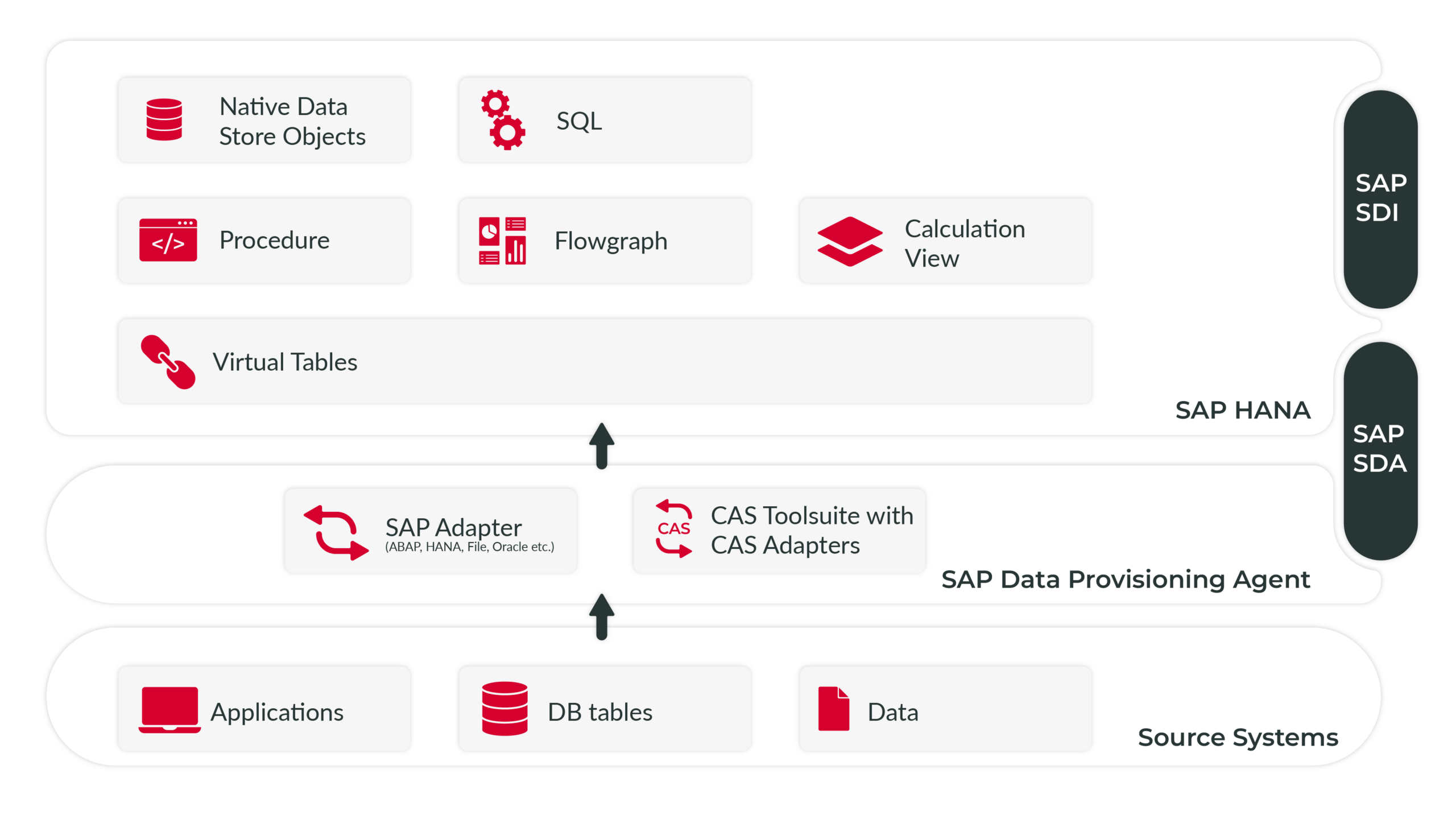
SAP Smart Data Integration (SDI) is the HANA-native integration suite of the SAP HANA platform. With SAP SDI, data from various internal and external sources can be retrieved, transformed, and stored in SAP HANA database tables, as well as made available to other target systems.
SAP SDI supports both traditional ETL (Extract, Transform, Load) processes for batch processing and data replication for real-time data availability, thereby offering a comprehensive solution for a wide range of data integration requirements.
Flowgraphs enable the graphical modeling of data flows by linking numerous available functions and operations for data processing. In addition, traditional procedures can be used; these are hidden behind the graphical representations of the flowgraphs and serve as an extremely flexible tool for implementing data transformations. These procedures are implemented in SQLScript, SAP’s proprietary SQL dialect. As a result, the SAP SDI integration suite meets the needs and requirements of various developers.
SAP HANA Smart Data Access – Real-Time Access to External Data
Efficient Data Integration Through Virtual Data Connections
With SAP HANA Smart Data Access (SDA), data can be retrieved from and processed in real time from other databases without having to copy it first. SAP SDA uses virtualization techniques to treat external data as if it were stored locally in SAP HANA. In this process, only the metadata is stored in the SAP HANA database, while the actual data is accessed directly in the connected target system. This enables efficient queries because SAP SDA offloads processing to the target system (code pushdown).
SAP SDA supports various source systems from the SAP family as well as common database management systems such as Oracle, Microsoft SQL Server, IBM DB2, and Apache Hadoop. With the help of adapters, SAP SDA can be extended to support a wide range of external data sources. These adapters act as bridges between SAP HANA and the various data sources. Custom adapters can be developed for specific data sources that are not yet supported.
Through its data federation approach, SAP SDA provides virtual data integration that can be used in both fully virtual data architectures and traditional data integration approaches to enable direct access to data sources or target systems. Further data transformation and processing is performed using SAP SDI functions.
SAP Smart Data Integration (SDI) is the HANA-native integration suite of the SAP HANA platform. With SAP SDI, data from various internal and external sources can be retrieved, transformed, and stored in SAP HANA database tables, as well as made available to other target systems.
SAP SDI supports both traditional ETL (Extract, Transform, Load) processes for batch processing and data replication for real-time data availability, thereby offering a comprehensive solution for a wide range of data integration requirements.
Flowgraphs enable the graphical modeling of data flows by linking numerous available functions and operations for data processing. In addition, traditional procedures can be used; these are hidden behind the graphical representations of the flowgraphs and serve as an extremely flexible tool for implementing data transformations. These procedures are implemented in SQLScript, SAP’s proprietary SQL dialect. As a result, the SAP SDI integration suite meets the needs and requirements of various developers.
With SAP HANA Smart Data Access (SDA), data can be retrieved from and processed in real time from other databases without having to copy it first. SAP SDA uses virtualization techniques to treat external data as if it were stored locally in SAP HANA. In this process, only the metadata is stored in the SAP HANA database, while the actual data is accessed directly in the connected target system. This enables efficient queries because SAP SDA offloads processing to the target system (code pushdown).
SAP SDA supports various source systems from the SAP family as well as common database management systems such as Oracle, Microsoft SQL Server, IBM DB2, and Apache Hadoop. With the help of adapters, SAP SDA can be extended to support a wide range of external data sources. These adapters act as bridges between SAP HANA and the various data sources. Custom adapters can be developed for specific data sources that are not yet supported.
Through its data federation approach, SAP SDA provides virtual data integration that can be used in both fully virtual data architectures and traditional data integration approaches to enable direct access to data sources or target systems. Further data transformation and processing is performed using SAP SDI functions.
SAP Smart Data Integration (SDI) is the HANA-native integration suite of the SAP HANA platform. With SAP SDI, data from various internal and external sources can be retrieved, transformed, and stored in SAP HANA database tables, as well as made available to other target systems.
SAP SDI supports both traditional ETL (Extract, Transform, Load) processes for batch processing and data replication for real-time data availability, thereby offering a comprehensive solution for a wide range of data integration requirements.
Flowgraphs enable the graphical modeling of data flows by linking numerous available functions and operations for data processing. In addition, traditional procedures can be used; these are hidden behind the graphical representations of the flowgraphs and serve as an extremely flexible tool for implementing data transformations. These procedures are implemented in SQLScript, SAP’s proprietary SQL dialect. As a result, the SAP SDI integration suite meets the needs and requirements of various developers.
With SAP HANA Smart Data Access (SDA), data can be retrieved from and processed in real time from other databases without having to copy it first. SAP SDA uses virtualization techniques to treat external data as if it were stored locally in SAP HANA. In this process, only the metadata is stored in the SAP HANA database, while the actual data is accessed directly in the connected target system. This enables efficient queries because SAP SDA offloads processing to the target system (code pushdown).
SAP SDA supports various source systems from the SAP family as well as common database management systems such as Oracle, Microsoft SQL Server, IBM DB2, and Apache Hadoop. With the help of adapters, SAP SDA can be extended to support a wide range of external data sources. These adapters act as bridges between SAP HANA and the various data sources. Custom adapters can be developed for specific data sources that are not yet supported.
Through its data federation approach, SAP SDA provides virtual data integration that can be used in both fully virtual data architectures and traditional data integration approaches to enable direct access to data sources or target systems. Further data transformation and processing is performed using SAP SDI functions.
Our expertise
Proven Integration Scenarios and Flexible Tool Suite Solutions from CAS AG
In the dynamic world of financial services, it is crucial that the right data is available at the right time, in the right format, and in the right place.
Our expertise, gained from numerous integration projects, encompasses the implementation of various integration scenarios as well as batch, real-time, and streaming interfaces between SAP and non-SAP systems using SAP SDI and SAP SDA. In addition to ourn proven Methods and comprehensiven Experienceen let’s use the CAS AG’s Tool Suite, to write code and artifacts from the Generate integration scenarios and complete integration flows fast and flexible to build.
Custom adapters for seamless system integration
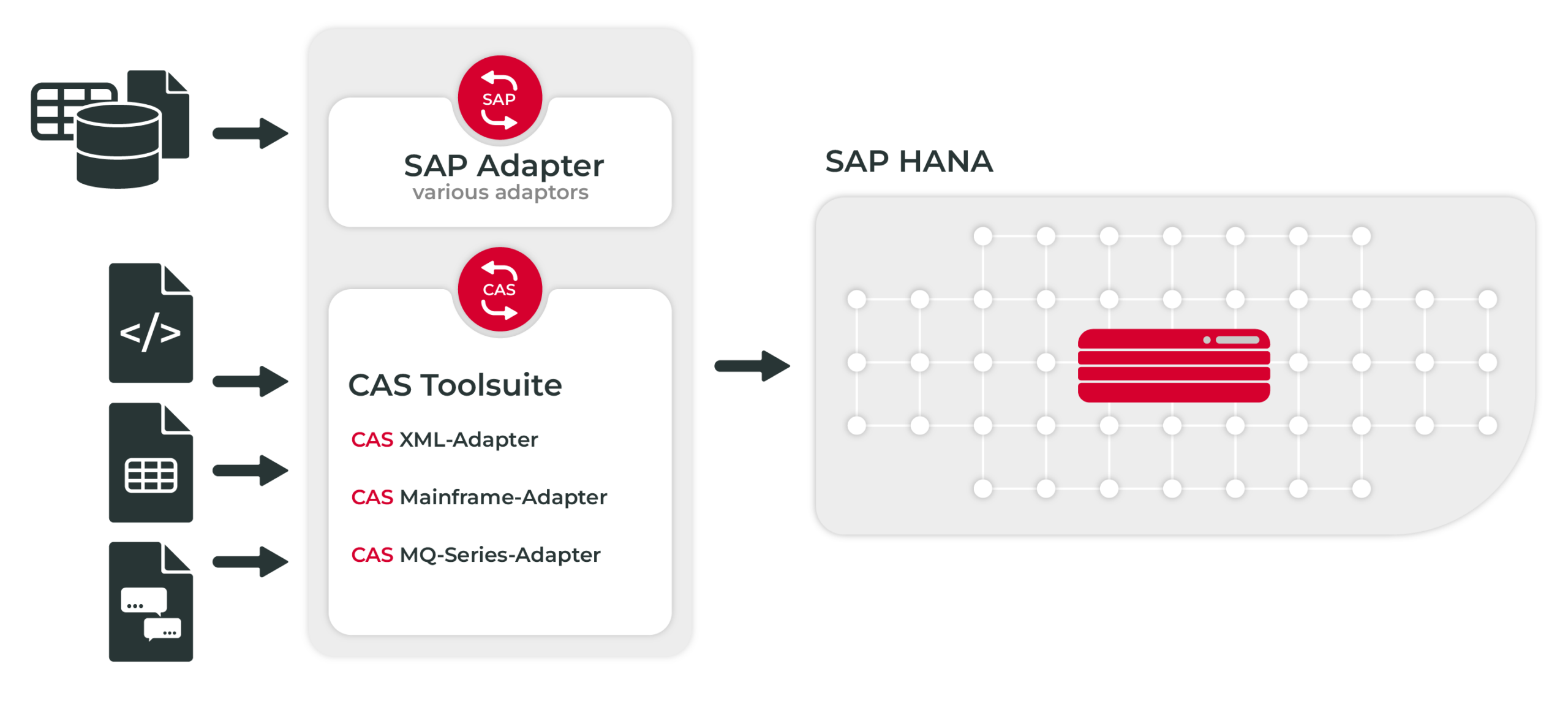
Thanks to our many years of experience with integration projects, we have developed numerous adapters that make it possible to connect data to the SAP HANA platform even when standard SAP adapters are not available. Our CAS adapters support the integration of large and complex XML files, fixed-length mainframe files, and messages from IBM MQ. We also develop custom SAP SDA adapters for your integration use case.
Real-Time Analysis and Virtual Data Architectures
Integration as a virtual table enables real-time access to all connected data sources. In addition, data federation approaches enable virtual data architectures and analyses without additional persistence on the SAP HANA platform.
Data Consolidation
Integrating various data sources into the SAP HANA platform as a single point of information—the foundation for efficient and flexible analytics. The data is integrated and transformed into a uniform, source-system-independent data structure in accordance with the platform’s requirements.
Implementation of a Custom-Developed SAP SDA Adapter
Use of our custom-developed SAP SDA adapters to integrate complex XML files, fixed-length mainframe files, and messages from IBM MQ into the SAP HANA platform.
Custom SAP SDA Adapters–Development
Development of additional custom SAP SDA adapters for any data sources and specialized solutions.
Proven Integration of SAP Systems
Specification and Implementation of the data integration from your SAP S/4HANA–system or other SAP products using native SAP SDA– & SAP SDI– interfaces—tailored to your requirements for batch or real-time integration
Custom Data Interfaces for Third-Party Systems
Specification and Implementation of Sinterfaces with third-party systems – both for data integration to as well as the data transfer from the SAP HANA–platform
Efficient Integration with Our Tool Suite
To efficiently implement integration interfaces, we use our own CAS toolsuite to accelerate projects
Integration as a virtual table enables real-time access to all connected data sources. In addition, data federation approaches enable virtual data architectures and analyses without additional persistence on the SAP HANA platform.
Data Consolidation
Integrating various data sources into the SAP HANA platform as a single point of information—the foundation for efficient and flexible analytics. The data is integrated and transformed into a uniform, source-system-independent data structure in accordance with the platform’s requirements.
Use of our custom-developed SAP SDA adapters to integrate complex XML files, fixed-length mainframe files, and messages from IBM MQ into the SAP HANA platform.
Development of additional custom SAP SDA adapters for any data sources and specialized solutions.
Specification and Implementation of the data integration from your SAP S/4HANA–system or other SAP products using native SAP SDA– & SAP SDI– interfaces—tailored to your requirements for batch or real-time integration
Specification and Implementation of Sinterfaces with third-party systems – both for data integration to as well as the data transfer from the SAP HANA–platform
To efficiently implement integration interfaces, we use our own CAS toolsuite to accelerate projects
Integration as a virtual table enables real-time access to all connected data sources. In addition, data federation approaches enable virtual data architectures and analyses without additional persistence on the SAP HANA platform.
Data Consolidation
Integrating various data sources into the SAP HANA platform as a single point of information—the foundation for efficient and flexible analytics. The data is integrated and transformed into a uniform, source-system-independent data structure in accordance with the platform’s requirements.
Use of our custom-developed SAP SDA adapters to integrate complex XML files, fixed-length mainframe files, and messages from IBM MQ into the SAP HANA platform.
Development of additional custom SAP SDA adapters for any data sources and specialized solutions.
Specification and Implementation of the data integration from your SAP S/4HANA–system or other SAP products using native SAP SDA– & SAP SDI– interfaces—tailored to your requirements for batch or real-time integration
Specification and Implementation of Sinterfaces with third-party systems – both for data integration to as well as the data transfer from the SAP HANA–platform
To efficiently implement integration interfaces, we use our own CAS toolsuite to accelerate projects