More Transparency and Control
Bring Structure and Efficiency to Your Billing Processes
As of January 1, 2025, all companies based in Germany that operate in the B2B sector must be able to receive e-invoices. Effective January 1, 2027, the reporting requirement applies to companies with prior-year revenue exceeding 800,000 euros (detailed requirements). Invoices must be in a structured, machine-readable format that complies with EN 16931. Starting January 1, 2028, e-invoices will be mandatory for businesses of all sizes. So far, so mandatory. But the new legal requirements offer businesses a real opportunity:
- Examine and optimize existing processes
- Driving Digital Transformation in the Company
- To make communication with customers and suppliers more efficient.
Take advantage of this transition to reduce manual invoicing processes and instead adopt a fully digital approach. With our centralized e-invoice processing solution, you can integrate the individual steps into a transparent and efficient end-to-end process—from the provision of invoice data through conversion, validation, and delivery to monitoring and archiving.
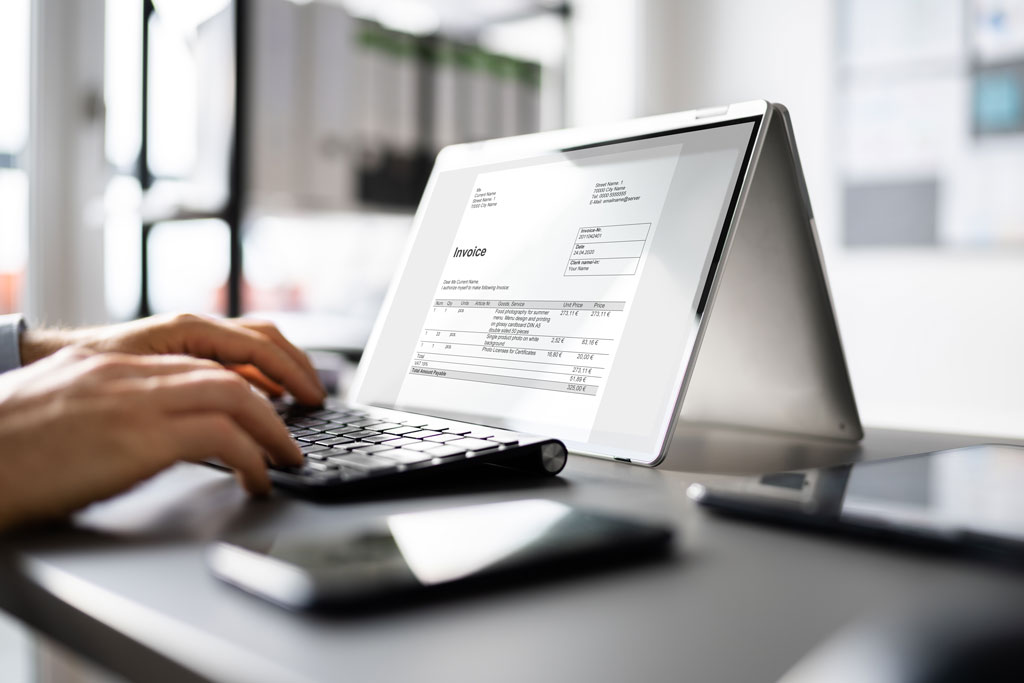
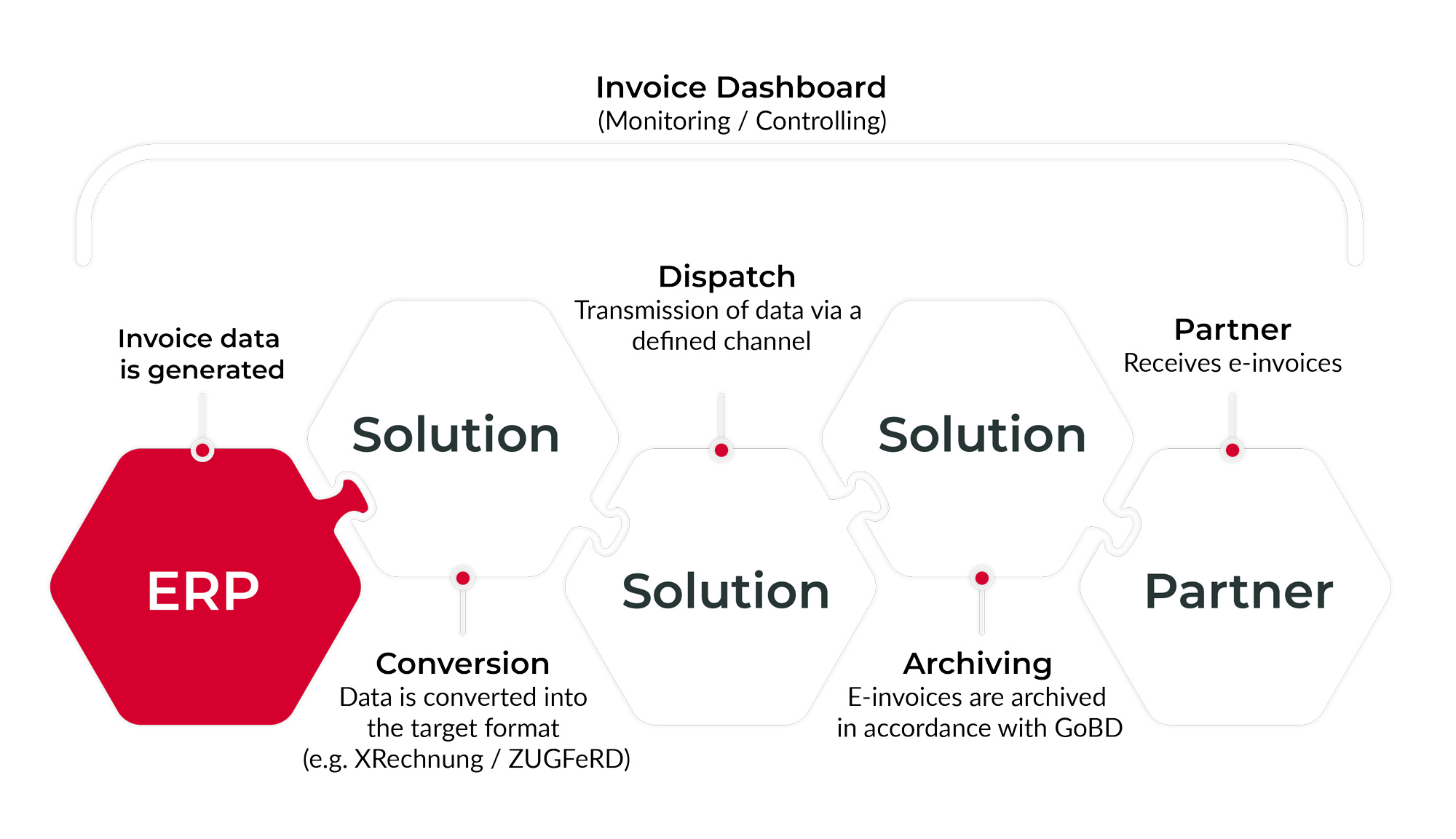
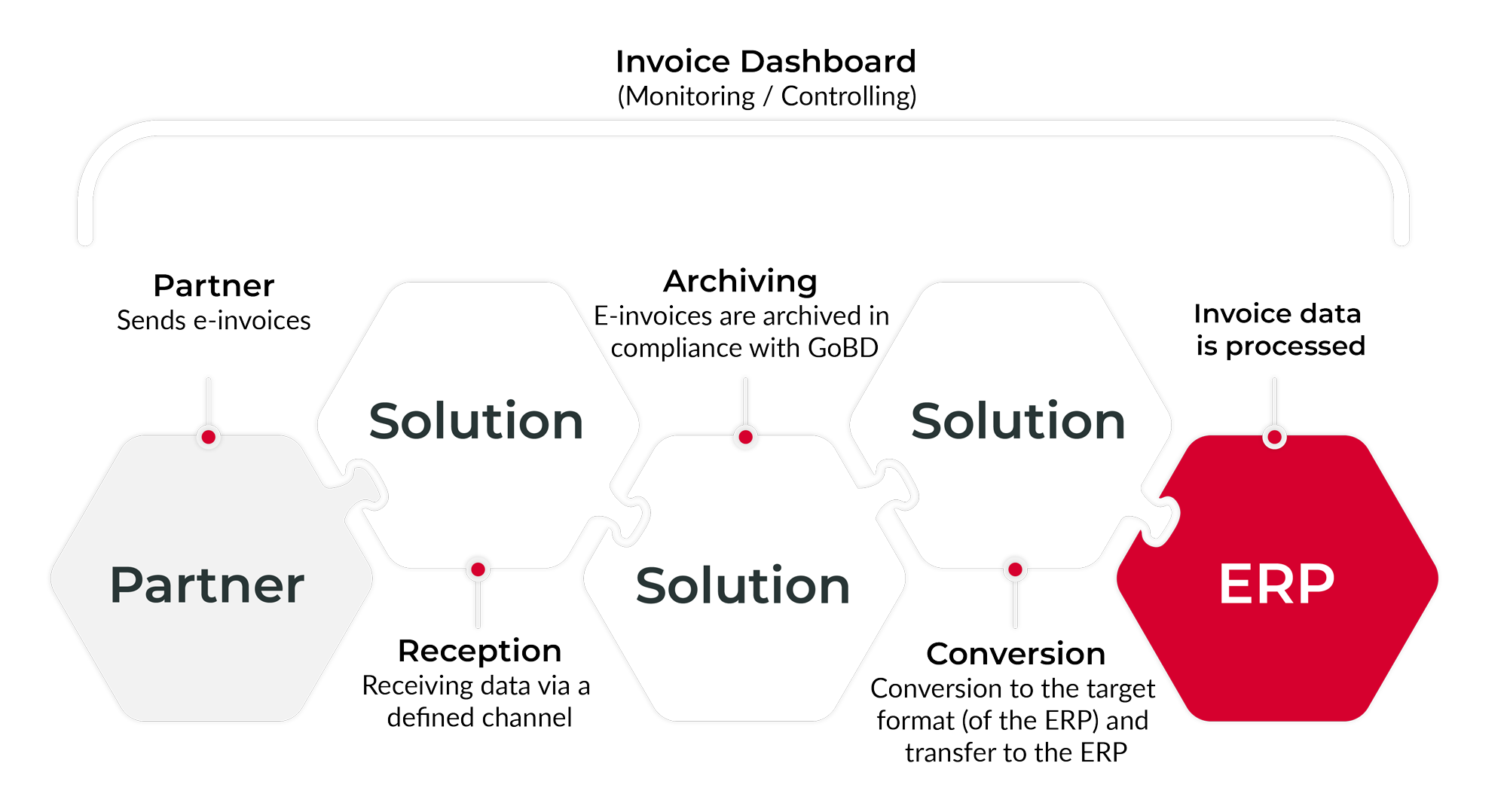
E-invoicing can be integrated into your existing system landscape: Invoice data is retrieved from your ERP system, converted into the required e-invoice format—such as XRechnung or ZUGFeRD—and sent to your business partners via the appropriate transmission channel. A central e-invoicing dashboard lets you keep track of the entire process. This way, you not only meet the requirements for e-invoicing but also lay the foundation for automated, transparent, and future-proof processes with your customers and suppliers.
As of January 1, 2025, all companies based in Germany that operate in the B2B sector must be able to receive e-invoices. Effective January 1, 2027, the reporting requirement applies to companies with prior-year revenue exceeding 800,000 euros (detailed requirements). Invoices must be in a structured, machine-readable format that complies with EN 16931. Starting January 1, 2028, e-invoices will be mandatory for businesses of all sizes. So far, so mandatory. But the new legal requirements offer businesses a real opportunity:
- Examine and optimize existing processes
- Driving Digital Transformation in the Company
- To make communication with customers and suppliers more efficient.
Take advantage of this transition to reduce manual invoicing processes and instead adopt a fully digital approach. With our centralized e-invoice processing solution, you can integrate the individual steps into a transparent and efficient end-to-end process—from the provision of invoice data through conversion, validation, and delivery to monitoring and archiving.
E-invoicing can be integrated into your existing system landscape: Invoice data is retrieved from your ERP system, converted into the required e-invoice format—such as XRechnung or ZUGFeRD—and sent to your business partners via the appropriate transmission channel. A central e-invoicing dashboard lets you keep track of the entire process. This way, you not only meet the requirements for e-invoicing but also lay the foundation for automated, transparent, and future-proof processes with your customers and suppliers.
As of January 1, 2025, all companies based in Germany that operate in the B2B sector must be able to receive e-invoices. Effective January 1, 2027, the reporting requirement applies to companies with prior-year revenue exceeding 800,000 euros (detailed requirements). Invoices must be in a structured, machine-readable format that complies with EN 16931. Starting January 1, 2028, e-invoices will be mandatory for businesses of all sizes. So far, so mandatory. But the new legal requirements offer businesses a real opportunity:
- Examine and optimize existing processes
- Driving Digital Transformation in the Company
- To make communication with customers and suppliers more efficient.
Take advantage of this transition to reduce manual invoicing processes and instead adopt a fully digital approach. With our centralized e-invoice processing solution, you can integrate the individual steps into a transparent and efficient end-to-end process—from the provision of invoice data through conversion, validation, and delivery to monitoring and archiving.
E-invoicing can be integrated into your existing system landscape: Invoice data is retrieved from your ERP system, converted into the required e-invoice format—such as XRechnung or ZUGFeRD—and sent to your business partners via the appropriate transmission channel. A central e-invoicing dashboard lets you keep track of the entire process. This way, you not only meet the requirements for e-invoicing but also lay the foundation for automated, transparent, and future-proof processes with your customers and suppliers.
Our expertise
Understand e-invoicing processes, be familiar with standards, and integrate systems.
For over 35 years, we have been developing and implementing solutions for electronic data exchange between companies. Our experience ranges from established EDI and industry standards to today’s e-invoicing requirements.
Whether it’s EDIFACT, EANCOM®, XRechnung, or ZUGFeRD: We are familiar with the various standards and formats and ensure that they are reliably integrated into your existing system landscape and business processes. To this end, we rely, among other things, on established GS1 standards to ensure standardized and efficient data exchange with customers and suppliers.
Our strength lies not only in our technology, but also in the combination of standards, integration, and process expertise. The result is an e-invoicing solution that fits your existing systems, the requirements of your business partners, and your specific processes.
Your benefits:
- Less Complexity in Data Exchange
- Standard-compliant and reliable processes
- Flexible Integration of New Business Partners
- High Level of Automation
- Long-Term Cost-Saving Potential
- The solution scales with your needs
Harnessing the Potential of E-Invoicing
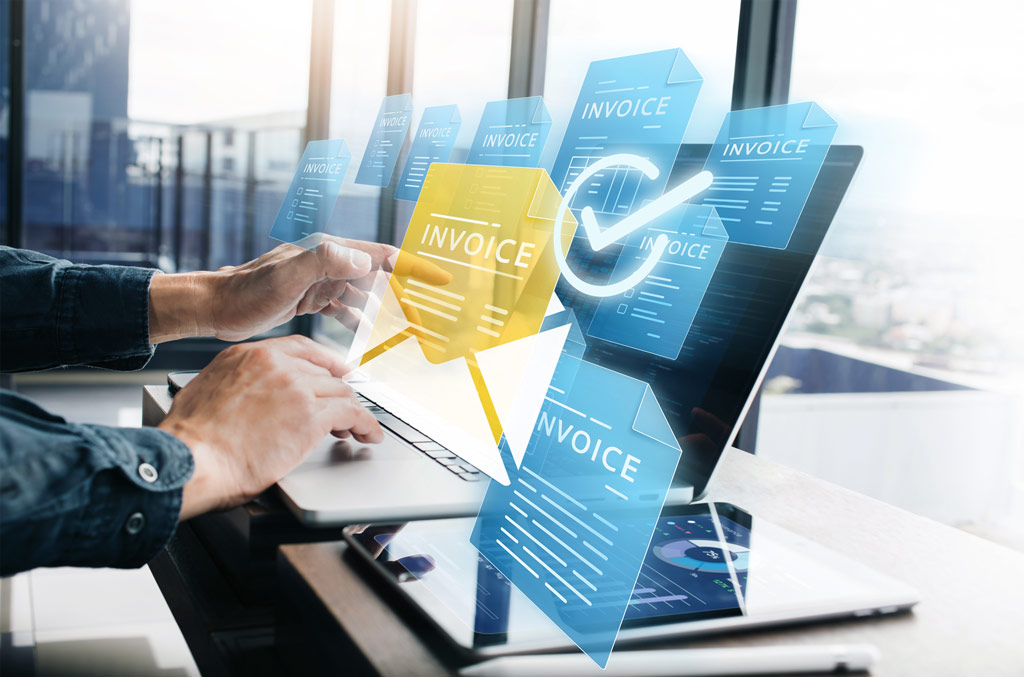
A centralized e-invoicing dashboard consolidates various systems and processes, creating end-to-end and transparent workflows. The e-invoicing requirement offers an opportunity to digitize existing processes and further develop your digitization strategy in a targeted manner.
Explore additional digitization options in the B2B and B2G sectors and take advantage of industry standards for automated communication, such as EDIFACT, EANCOM, XRechnung, and ZUGFeRD.
Watch our webcasts to learn how we can help you comply with the e-invoicing requirement.

Your Starting Point —Where Do You Stand?
Getting Started with E-Billing
You want to know what you need and how to prepare your existing systems.
Supplement EDI processes
Existing connections should be maintained and expanded to include e-invoicing requirements.
Complex customer and supplier requirements
The goal is to enable centralized management of different formats, channels, and partners.
Getting Started with E-Billing
You want to know what you need and how to prepare your existing systems.
Existing connections should be maintained and expanded to include e-invoicing requirements.
Complex customer and supplier requirements
The goal is to enable centralized management of different formats, channels, and partners.
You want to know what you need and how to prepare your existing systems.
Existing connections should be maintained and expanded to include e-invoicing requirements.
Complex customer and supplier requirements
The goal is to enable centralized management of different formats, channels, and partners.
FAQ E-Invoicing Requirement
1. Will e-billing be mandatory starting in 2027?
E-invoicing has been gradually becoming mandatory since January 1, 2025.
Effective January 1, 2027, all B2B companies based in Germany must be able to receive and send invoices in a structured, machine-readable format in accordance with EN 16931. An exception applies to companies with annual total revenue of less than 800,000 euros, which will be required to comply starting January 1, 2028.
Paper invoices and PDF files are no longer sufficient for this purpose. EDIFACT and other compatible formats can still be used.
2. What does the e-invoicing requirement mean?
The e-invoicing requirement involves the phased introduction of receiving and sending structured electronic invoices, as well as the associated requirements for formats, processes, and systems. Companies can benefit from advantages such as time and cost savings in the long term.
3. Who is subject to the e-invoicing requirement?
In general, all companies are subject to the e-invoicing requirement and must be able to receive electronic invoices as of January 1, 2025.
Since the requirement to send e-invoices is being phased in gradually, exceptions apply until December 31, 2027, for the issuance and transmission of invoices by businesses with total annual revenue of < 800,000 euros.
Starting January 1, 2028, all companies must be able to receive, issue, and send invoices.
4. Is e-invoicing via SAP mandatory?
Structured and electronic formats are mandatory (CEN Standard EN 16931). For example, the XRechnung and ZUGFeRD formats can be created and sent directly from SAP using an SAP add-on solution.
5. How does CAS AG assist with the implementation of the e-invoicing requirement?
CAS AG helps companies comply with the e-invoicing requirement. By integrating a central e-invoicing platform into the existing system landscape, we help companies achieve greater transparency and control, as well as a future-proof foundation for electronic invoice exchange.
Through our collaboration with our partner companies, we offer a wide range of solutions and options. We provide consulting services regarding both the technical design and the implementation.
1. Will e-billing be mandatory starting in 2027?
E-invoicing has been gradually becoming mandatory since January 1, 2025.
Effective January 1, 2027, all B2B companies based in Germany must be able to receive and send invoices in a structured, machine-readable format in accordance with EN 16931. An exception applies to companies with annual total revenue of less than 800,000 euros, which will be required to comply starting January 1, 2028.
Paper invoices and PDF files are no longer sufficient for this purpose. EDIFACT and other compatible formats can still be used.
2. What does the e-invoicing requirement mean?
The e-invoicing requirement involves the phased introduction of receiving and sending structured electronic invoices, as well as the associated requirements for formats, processes, and systems. Companies can benefit from advantages such as time and cost savings in the long term.
3. Who is subject to the e-invoicing requirement?
In general, all companies are subject to the e-invoicing requirement and must be able to receive electronic invoices as of January 1, 2025.
Since the requirement to send e-invoices is being phased in gradually, exceptions apply until December 31, 2027, for the issuance and transmission of invoices by businesses with total annual revenue of < 800,000 euros.
Starting January 1, 2028, all companies must be able to receive, issue, and send invoices.
4. Is e-invoicing via SAP mandatory?
Structured and electronic formats are mandatory (CEN Standard EN 16931). For example, the XRechnung and ZUGFeRD formats can be created and sent directly from SAP using an SAP add-on solution.
5. How does CAS AG assist with the implementation of the e-invoicing requirement?
CAS AG helps companies comply with the e-invoicing requirement. By integrating a central e-invoicing platform into the existing system landscape, we help companies achieve greater transparency and control, as well as a future-proof foundation for electronic invoice exchange.
Through our collaboration with our partner companies, we offer a wide range of solutions and options. We provide consulting services regarding both the technical design and the implementation.
1. Will e-billing be mandatory starting in 2027?
E-invoicing has been gradually becoming mandatory since January 1, 2025.
Effective January 1, 2027, all B2B companies based in Germany must be able to receive and send invoices in a structured, machine-readable format in accordance with EN 16931. An exception applies to companies with annual total revenue of less than 800,000 euros, which will be required to comply starting January 1, 2028.
Paper invoices and PDF files are no longer sufficient for this purpose. EDIFACT and other compatible formats can still be used.
2. What does the e-invoicing requirement mean?
The e-invoicing requirement involves the phased introduction of receiving and sending structured electronic invoices, as well as the associated requirements for formats, processes, and systems. Companies can benefit from advantages such as time and cost savings in the long term.
3. Who is subject to the e-invoicing requirement?
In general, all companies are subject to the e-invoicing requirement and must be able to receive electronic invoices as of January 1, 2025.
Since the requirement to send e-invoices is being phased in gradually, exceptions apply until December 31, 2027, for the issuance and transmission of invoices by businesses with total annual revenue of < 800,000 euros.
Starting January 1, 2028, all companies must be able to receive, issue, and send invoices.
4. Is e-invoicing via SAP mandatory?
Structured and electronic formats are mandatory (CEN Standard EN 16931). For example, the XRechnung and ZUGFeRD formats can be created and sent directly from SAP using an SAP add-on solution.
5. How does CAS AG assist with the implementation of the e-invoicing requirement?
CAS AG helps companies comply with the e-invoicing requirement. By integrating a central e-invoicing platform into the existing system landscape, we help companies achieve greater transparency and control, as well as a future-proof foundation for electronic invoice exchange.
Through our collaboration with our partner companies, we offer a wide range of solutions and options. We provide consulting services regarding both the technical design and the implementation.