Two Ways to Efficiently Transition to Digital Invoicing
How can the transition be carried out efficiently—without adding unnecessary complexity to the project—in both SAP and non-SAP environments?
With the mandatory implementation of electronic invoicing effective January 1, 2027, companies are facing a fundamental turning point. Structured formats such as XRechnung and ZUGFeRD are replacing PDFs and paper —and require adjustments to existing system infrastructures. But which implementation strategy makes more sense: an integrated, system-independent solution, or an add-on directly within the ERP system?
In this webcast, you’ll learn about two specific approaches that illustrate why, depending on the initial situation, a customized solution, a standard solution—or a hybrid approach—is the most efficient and sustainable option. An integrated, system-independent solution for electronic invoice data exchange, as well as an SAP add-on that allows you to create and send XRechnung and ZUGFeRD invoices directly from SAP.
Which adjustments are actually necessary in the existing system and process landscape—and which ones are often overestimated? The webcast will conclude with an open Q&A session with experts. The goal is for you to leave the meeting with a realistic assessment, clear recommendations for action, and a specific next step—not just another to-do list. If you don’t yet have a plan for implementing e-invoicing, this webcast is the perfect place to start.
E-Invoicing 2027: Why You Should Take Action Now
The requirement to use electronic invoicing is no longer a future option, but a clear legal development with a binding timeline. As of January 1, 2025, companies must be able to receive electronic invoices. In the coming years, there will be a gradual, mandatory transition to the use of structured, machine-readable formats such as XRechnung and ZUGFeRD.
Step-by-Step Introduction
by 2028
Starting in 2028 at the latest, electronic invoice exchange in the B2B sector will be mandatory for all companies. PDF and paper invoices are thus finally losing their relevance in business transactions.
But the real challenge lies not in the law—but in its implementation.
Companies must adapt their ERP and system landscapes—whether SAP or non-SAP—from a technical, organizational, and process perspective.
Those who start too late risk unnecessary project overhead, bottlenecks in IT resources, and rising implementation costs.
It affects not only IT, but also processes and collaboration.
E-invoicing involves: formats, delivery methods, validation, error handling, archiving, master data quality—and the collaboration between business departments, IT, and external partners. Make strategic decisions now instead of reacting later under time pressure!
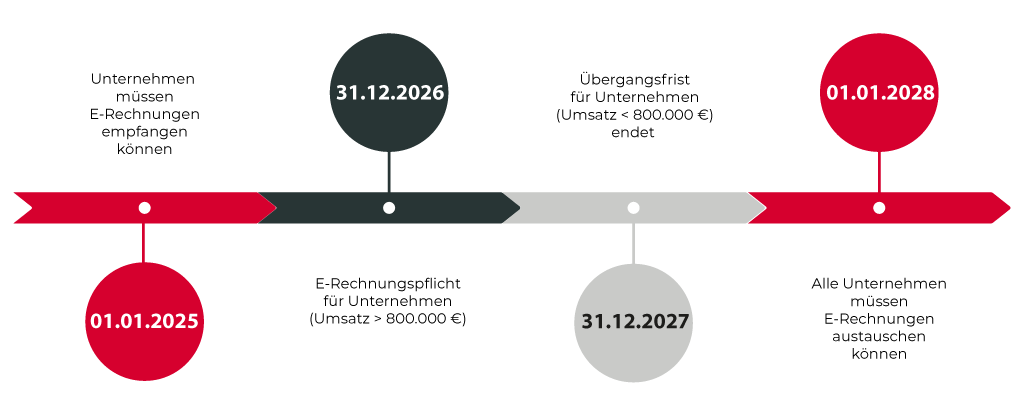
The transitional provisions in place through the end of 2027 provide some flexibility—but do not delay the planning process. Companies with annual revenue exceeding 800,000 euros, in particular, should clarify the following at an early stage:
What might implementation look like in practice?
What adjustments are really necessary?
Is an expansion of the existing ERP system sufficient?
Or does an integrative, system-independent solution make more sense in the long run?
The requirement to use electronic invoicing is no longer a future option, but a clear legal development with a binding timeline. As of January 1, 2025, companies must be able to receive electronic invoices. In the coming years, there will be a gradual, mandatory transition to the use of structured, machine-readable formats such as XRechnung and ZUGFeRD.
Starting in 2028 at the latest, electronic invoice exchange in the B2B sector will be mandatory for all companies. PDF and paper invoices are thus finally losing their relevance in business transactions.
But the real challenge lies not in the law—but in its implementation.
Companies must adapt their ERP and system landscapes—whether SAP or non-SAP—from a technical, organizational, and procedural standpoint.
Those who start too late risk unnecessary project effort, bottlenecks in IT resources, and rising implementation costs.
It affects not only IT, but also processes and collaboration.
E-invoicing involves: formats, delivery methods, validation, error handling, archiving, master data quality—and the collaboration between business units, IT, and external partners. If you start early, you can make decisions instead of just reacting.
The transitional provisions in place through the end of 2027 provide some flexibility—but do not delay the planning process. Companies with annual revenue exceeding 800,000 euros, in particular, should clarify the following at an early stage:
What might implementation look like in practice?
What adjustments are really necessary?
Is an expansion of the existing ERP system sufficient?
Or does an integrative, system-independent solution make more sense in the long run?


Schedule an exchange!